Showing posts with label album. Show all posts

Tuesday, 6 October 2009

Review: The Life Of The World To Come by The Mountain Goats


Of Beginnings

A bassy, palm-muted, minimalist acoustic guitar. Dabbings of bass drum and an occasional hissing, rattling hi-hat. The Life Of The World To Come by The Mountain Goats starts brilliantly. Lyrically, the opening is similarly strong:

I became a crystal healer
and my ministry was to the sick
creeping vines would send out runners
and seek me in their numbers
I sold self-help tapes
Go down to the netherworld, plant grapes

It's been a while since my attention was so rapaciously grabbed by the first few bars of an album. And the first song ('1 Samuel 15:23') is, I'd say, pretty much faultless. An intense, enigmatic lyrical voice. Sparse instrumentation extremely skilfully recorded and superbly produced. Brooding, ominous. Unshakeably it establishes a thickly pervasive atmosphere for the entire record. Sets (if you will) the stage. It's as good an opener as 'Airbag' is to ok computer.

And that's good.

So – how about you download an mp3 of 1 Samuel 15:23 by the Mountain Goats? Come back when you're done, won't you?


Of Good Music

Good music means something to its producers. It's not just spewed out from refinery to factory to outlet.

Good music demands; it communicates. Expresses.

And The Life Of The World To Come is the most interesting album I've listened to since Bill Callahan's Sometimes I Wish We Were An Eagle. World To Come isn't as clever (from a literary point of view, or with respect to its songcraft) as Eagle. But it's cleverer than most. And, in common with Callahan's record, it is saturated with powerful, intense, thoroughly sincere emotion.

Now, Heavy Soil doesn't know about you, but Heavy Soil grows immensely tired of the capriciously ironical 'whimsy' and trendily self-aware posturing that dominates the alternative/folkish musical genres.

So a bit of emotional saturation goes down very well with us.


Of Versatility

Musically, the early stages of the record demonstrate a good deal of versatility: the sparseness of the opener gives way (excellently) to the spitting, pulsing, juddering momentum of 'Psalms 40:2'. As the album progresses, there's less pronounced contrast between songs (a pity), but musical imaginativeness is evident in some lovely string arrangements (don't expect swooning orchestral lines: these are sparse, dry, intelligent.)

And one of the most commendable of the features on display is musical restraint. Download an mp3 of the lovely Hebrews 11:40, won't you? Notice the point (around 2:20) at which the arrangement swells toward a climax, only to pull back at the last moment.

Excellent.


Of themes
(always the most boring and obvious part of an English essay, so I'll keep it short)

The Life Of The World To Come is, conceptually, a very tight album. It is unified by clear and consistent themes – the clearest of which (revealed by a single glance at the 100% biblical tracklisting) is religion/faith. We'll come back to this later – you bet.

Less overtly, the songs are bound together by strands of imagery (cars, sickness, the domestic) and feeling (detachment, introspection, passivity). This is a very cohesive piece of work. And imbuing the whole record is a narrative (played out without linearity) of death and bereavement.


Of theological wrangling

So, it's going pretty well, so far. You'll be surprised then, perhaps, to discover that The Life Of The World To Come has nevertheless been giving me – your beloved reviewer – some trouble.

'Romans 10:9' is the crux of it. Without ado, here's the chorus:

If you will believe in your heart
And confess with your lips
Surely you will be saved one day

Uh huh.

Now, my review-writing muse – an enigmatic character known only as FieldVole – was pretty down on this. She called it 'Praise music'. And, in isolation, that's a criticism (and boy did she mean it as a criticism…) I cannot counter. I don't much like pop songs of the ilk implied by those lyrics above. It reminds me of awful freshers' week experiences. Christian Rock.

But hold on a minute. Wasn't it TS Eliot that wrote –

Pray for us sinners now and at the hour of our death
Pray for us now and at the hour of our death

– and suchlike? Yes, it was indeed. Of course, there's no comparison between the two in terms of poetry (Eliot's lines are brilliantly written); but it's clear enough that Eliot (along with many, many other poets and novelists whom I admire) produce work that explicitly deals with Christian faith and the issues surrounding it.

So I should be clear: I have absolutely no problem with art – be it a poem, a song or a painting – that's created from an explicitly religious perspective. I would never decry a creative work because it was written from a Christian perspective. 'Ash Wednesday' (from which those above lines of Eliot's are quoted) is one of my favourite poems.

The problem with 'Romans 10:9', though, is that it is bland. Not only lyrically, but also musically (over to FieldVole again, who crushingly pointed out the song's slight whiff of 'keyboard demo'. Ouch.) And so much else on this album is far from bland. Indeed, 'Romans' is so bland that, on my first few listens, I didn't even notice it. And was preparing myself to write a resoundingly positive review of the album.

Then FieldVole came in with her 'Praise Music' jibes. And I had to think again.


There's a defence (of course there's a defence: there's always a defence). Here's the chorus of 'Philippians 3:20-21':

Nice people say he has gone home to God now
Safe in his arms, safe in his arms
But the voices of the angels singing to him in his last hours with us:
Smoke alarms. Smoke alarms.

The idea is, then, that we're being led through a series of perspectives on questions of faith. The 'Smoke alarms' is our moment of camera-panning-out-to-an-empty-room objectivity. The grounding. It's like the end of Lord of the Flies (the novel, yeh?), at which we see the warring boys suddenly and powerfully through the eyes of the first and only adult in the novel.

A WHOOOMP-type moment.

So this treatment of faith – at once exploratory and sceptical – gives us a cue to take a song like 'Romans 10:9' (the bland one, right? I know: all these biblical names may make for conceptual unity, but they're bloody confusing) as just representative of one perspective. One voice. It's not supposed (I assume) to be preachy.

Problem is, it's just not a particularly convincing song. Sorry.


Of Non-Blandness

But I want to return to this: there are some truly superb things on this record. And let it be indicative of my overall feeling that I choose to close on this note.

First off, the album's final song, 'Ezekiel 7 and the Permanent Efficacy Of Grace', is brilliant. It draws together the themes and imagery (it seems to me) in an almost faultless way. And it's musically sparse, haunting, atmospheric. A mirror image of the opening.


And, finally, let's talk about 'Matthew 25:21', which I'd take to be the record's core. It charts the journey of the narrator for a last visit to a terminally ill person (a relative, we presume). The first time I listened to the album, I was not prepared for the intensity of this song – and the degree to which, by the time it played, my attention had been transfixed. Emotionally, it is sparingly effective. And lyrically. Lyrically, it is very, very good. Here's the best bit of the whole album. Right here:

I felt all the details
Carving out space in my head
Tropicanas on the walkway
Neon red.

This is fucking excellent. Absolutely superb. It's why I love literature. Because it simply, elegantly, unfussily describes a sensation that is both complex and 100% familiar and convincing: in this instance, the foreknowledge of nostalgia to come.

If only this kind of lyrical pellucidity could carry through to those small islets of blandness. That's all I want to say.

Monday, 29 June 2009

Review: Far by Regina Spektor


I always worry when I'm writing a review of an album and I find myself saying 'tracks' instead of 'songs'.

Regina Spektor's new album, Far, has – I'm sorry to say – tracks.


So, this is how this is going to go.

First, I'm going to rant for a while about the production of this album. Then, once I'm puce and quivering, with dilated pupils and bubblettes of saliva flecking my lip, I'll take a subhead-break and write about the music. Because, dressed up as tracks though they may be, there are some lovely songs mewling and scrabbling, trapped within.

So let's rescue the poor critters.


But first…

Those of you who've followed Heavy Soil for a while will (I hope) realise that clever production techniques are very much Okay By Us. Heavy Soil certainly does not believe that all music should be lo-fi 4-track recordings of rattling plywood guitars and cheese-grater vocals captured by a Fisher Price microphone.

Because brilliant production makes Heavy Soil very happy.

But here's the problem with Far. Regina Spektor has worked, on this album, with people who are (no doubt) considered frigging top-notch arrangers. Frigging top-notch producers. Frigging top-notch session musicians. All the ingredients, one might suppose, of frigging top-notch production.

Indeed, Pitchfork, in its impressively wrong-headed review, has its own boringly brown-nosed paragraph lauding the skills of the 'four top-flight producers'.


Top-flight. Top-notch. Blah blah, lick lick, suck suck. Whatever.

All very well. But sometimes the top notch is smooth and symmetrical and perfectly machine-hewn.

Fucking boring, in other words. A big, smug, satisfied swot of a notch.

Sometimes, it's the top notch but one that we actually want.

Think about the old Regina song 'Poor Little Rich Boy': a left-hand piano line and a drumstick being lashed like a whip into a bar-stool. Name me one 'top-notch' arranger who'd think to do that.

No, they'd be too busy with their sumptuous string lines, telephoning their fellow top-notch arranger mates to brag about their wonderfully recherche brass section motifs.

You see, I don't want Regina Spektor's playing and arrangements to sound like Ben Folds + Tori Amos + Elton John + Fiona Apple. And I like all the aforementioned. But Regina plays piano in a totally different way. Not necessarily better. But different. So I don't want it to be dragged into line with the standard 'piano-based artist' sound.


Allow Heavy Soil to Let You Into A Secret

Because the thing with the big music industry is: it's enormously conservative. It far more reliably elevates those who perfect conventional arrangement/production than it does those who innovate. Regina Spektor is leagues more innovative than anybody she's worked with on this album. Leagues. And I don't care if I set a load of muso geeks and production obsessives flapping and whinging by saying it. I don't care how many great artists these people have worked with. Just like I don't care how many artists have banked at fucking HSBC.

Because, on Far, Regina Spektor has been tamed by a horde of collaborators whose talent is in no doubt, but whose influence is radically normalising.

And on this album, I see – clearly – the fingerprints of sweaty-palmed men who get off on the glossily sterile sound of a perfect hi-hat. Fetishistic production myopia. And, sure, the hi-hats kick ass. But in the same way as a trillion immaculately-processed hi-hats have kicked ass before.

And there's all this processed human beat-boxing. Regina is very, very good at her own (organic) brand of human beatbox. Listen to her doing it live and see what I mean. By using digital techniques to mimic this, her producers TOTALLY DESTROY THE POINT OF IT. Human beat box is all about imitating electronic percussion. So using electronic production techniques to imitate human beat box is staggeringly pointless. Perhaps somebody thought it was wittily ironic.

It's not. It's stupid.

And, on the subject of production techniques, another thing that really annoys: the fact that this record is mastered so loud that, at not-particularly-rare intervals, the music clips on my (120-pound) headphones. So the climactically loud parts are spoilt by those irritating hisses/rattles that occur when the volume has been pushed so hard that it actually overloads the speakers through which it's playing. This is massively, massively annoying. If I want my music louder, mastering-man, I'll sodding well turn up my volume. I don't need you raising the floor until my neck is bent 90 degrees and my head is pressed against the ceiling.


And, um – the good bits?

Okay, so I've been fairly down on the production, so far. In fact, there's some good stuff to say about it. Regina's voice is very nicely captured, sweet-toned and characterful. And, on some songs, the production is imaginative and colourful – 'Machine', for instance, in which industrial clunks and whirrs mesh with bit-crushed kit and treated vocals to good effect.


I'm still not convinced, mind, that I'd not have preferred it raw. But at least the production is taking the song somewhere, and doing it in an interesting, valid way. Even if it's spiritually pretty close to the (superior) 'Apres Moi' from Begin To Hope – crashingly Slavic chord sequence, hip-hop stylings and all.

But what if I imagine these were all acoustic recordings, shorn of glossy effects and processing? What, in other words, about the songs?

Some of them are very good indeed.

'Human of the Year' is probably the best. It's old-skool Regina – like 'Oedipus' (one of her very best), it is an embarrassment of thematic riches ... a song with about three potential choruses, none of which is milked to anything remotely approaching its capacity (meaning, to stretch a metaphor on my verbal rack, that instead of a pint of semi-skimmed, you end up with a few mouthfuls of Guernsey double cream.)

A pity, then, that somebody decided to whack in some wanky synths and gratuitous reverb (yes, I know the song mentions cathedrals. It's therefore the most fucking obvious production gimmick IN THE WORLD, EVER to add cathedral reverb onto the lead vocal. That's bloody Chris de Burgh territory, for Christ's sake).

Anyway, why don't you download an mp3 of Regina Spektor's Human of the Year and see if you agree with me?

Second track (yes, track) 'Eet', meanwhile, is enjoyable – though once again, I find myself unable to identify much in it that's not done at least as well in Begin To Hope (its equivalent on that record is probably 'On The Radio' – again, superior).

I'm not so convinced by the reggae-tinted album opening provided by 'The Calculation', which seems rather lite; nor by the frothy 'Folding Chair', which doesn't ever really transcend its (winkingly?) simplistic chord sequence. And, in all, I think there's less on this record that excites me from a songwriting point of view than on its predecessors. Of course, it's pretty hard to determine exactly to what degree this is down to production values that actively suppress pianistic innovation of the kind that's often my favourite aspect of Regina's music.

Then there are the vignettes. Take 'Genius Next Door'. Like others on the record, it's very affecting in places. But, to my ears, it doesn't especially benefit from the spangles of Disneyfication: reechoing reverb, glittering backing vocals, swooping strings. The vignette is more effective when dispensed casually. It lets a song shine (as this one should: it has a lovely melody) like an unexpected, unpolished pearl. Conversely, there's something about 'Big' production that endows songs like this with a grandiosity. Makes them seem as if they're Trying To Say Something. And I think that often undermines their power.


Have you noticed my problem, here, yet?

I try and write about the songs, but keep getting drawn back to the production. Because I really can't separate the two – so greatly does the latter seem to force its way into the former's territory.

If the songs on this album were to be released in a stripped-down, acoustic form, I suspect I'd gladly abandon in their favour all but two or three of these 'produced' versions.

But I suspect, too, that even then I'd not be calling 'Far' a triumph. Too many of these songs have their precedent in those on Begin To Hope – a record which far more successfully combined Big production with strong, original songwriting. Too few of them, taken as a whole, are exciting.

Tuesday, 2 June 2009

Review: Dragonslayer by Sunset Rubdown


So – later this month, Sunset Rubdown release their new record, Dragonslayer.

My first acquaintance with Sunset Rubdown came in the form of their previous album, Random Spirit Lover. I still remember sitting on a dark coach (sadly, the petrol-propelled rather than horse-drawn variety) gazing at the smeared lights of London through a window lashed by the rain, with wildly cascading scales and arpeggios ringing in my ears, and feeling myself suddenly encaptivated.

(It was only later that the congruence between that view through my window and the album's artwork struck me.)

Amongst other things, I loved the witty juxtapositions of sound, key and lyric. Most of all, I loved its joyous haphazardness, its infectious mania. It was definitely one of my favourite albums of 2007 (2007? Bloody hell, that's two years ago!) – and sparked an ongoing admiration for the band.

So you may well imagine that I have been eagerly anticipating Dragonslayer. And I stubbornly refuse to apologise for the fact that I shall doubtless be measuring it up, herebelow, against the yardstick of Random Spirit Lover.


Okay then, Heavy Soil – get out your yardstick

First song 'Silver Moons' establishes the pace in the same way that the excellent 'The Mending of the Gown' did for 'Random Spirit Lover'. But where 'The Mending...' was helter-skelter, bubbling over, madly inventive, scarcely contained, 'Silver Moons' is measured, atmospheric, grandiloquent. There's a heaviness here that's quite a departure from Random Spirit Lover's flightiness.

To me, the record approaches, at times, the sound of Wolf Parade (one of lead vocalist Spencer Krug's several other musical outfits).

And with the move away from flightiness, there's also a move in the direction of higher-fi. That's not to say that this is a glossily produced release – but the rawness of Random Spirit Lover (with its grittily massive kick drum sounds and oh-so-brittle guitars) is decidedly tamed, here – resulting, perhaps, in a more balanced mix ... but (to Heavy Soil's ears) one that's also less charming, more conventional.

The band recaptures the thrill of the earlier album fitfully. 'You Go On Ahead (Trumpet Trumpet II)' kicks satisfyingly into its outro, with the sense of surging into a home straight ... And there's still musical wit in here. The little guitar soloed snatch of 'We Wish You A Merry Christmas' in 'Silver Moons', the pass-the-parcel countermelodies of 'Apollo And The Buffalo And Anna Anna Anaa Oh!'...


So, yes, let's talk about more of the good stuff

'Idiot Heart' is a standout track – possibly the album's best (we've already written about the song in isolation, but – for your convenience, here's a link to Idiot Heart mp3). 'Black Swan' is also pretty kickin', with its eerily insistent taps, snaps and clicks, and sudden tempestuous gusts of sweeping melody. It's no coincidence, I suspect, that these are two of the record's most uptempo and dynamically varied songs.


The heavy sinuousness of closing track 'Dragon's Lair' (= Dragonslayer, if you say it aloud, see?) is handled well, and the song justifies its ten-and-a-half-minute length, as themes (both lyrical and melodic) are teased out and organically developed.

And there are still those ebullient surges into Casio toy keyboard tomfoolery – but they're somehow a bit more sensible, a bit less adventurous, a bit more subdued.


Subdued, you say?

Yes, subdued.

Everything about this record feels safer than Random Spirit Lover. And perhaps that means more people will like it [what do you mean, 'jadedly cynical'? This is a music blog, damn it: what did you expect?]. But Sunset Rubdown have taken a step away from the territory that made them so interesting to me.

That's not to say there's nothing new here. There's more extensive (and effective) use of Camilla Wynne Ingr's backing vocals, which often superbly offset Spencer Krug's reedy squawks. And there's perhaps more consideration given to the delicacies of arrangement and mix – a more transparent sound – which allows details to shine through.

But there's nothing here that surprises me.

And I like surprises.

(Surprise presents are particularly nice. Postal address provided on request.)


So what you're saying is ...?

What I'm saying is: this is quite a good album. If I hadn't been bewitched and betwitched by Random Spirit Lover and were coming at this afresh, it would certainly be strong enough to make me take notice. It's just that, relative to the slapdash brilliance of the band's earlier work, it's slightly disappointing.

Get this: not enormously disappointing. Just slightly.


The omnipresent disclaimer: the mp3s herefromlinked are provided to allow you better to gain an impression of Sunset Rubdown's work. If you like, 'em, please go and preorder the album (Amazon UK)

Wednesday, 27 May 2009

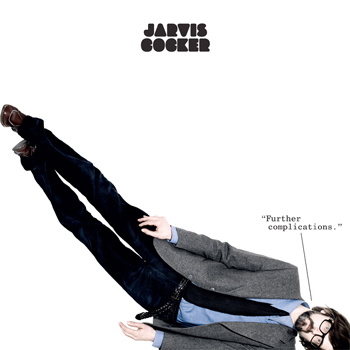
Review: Further Complications by Jarvis Cocker

Great artwork, by the way


I absolutely understand why some people would find themselves utterly turned off by Jarvis Cocker. He is deeply, deeply self-conscious in a way that has the potential to be frustrating, especially if interpreted as clever-clever yet empty irony.

I, however, am an enthusiastic admirer. One of the first five or six albums I owned was Pulp's This Is Hardcore – an album I'd still rank amongst the most sublime of my record collection. And I really don't think he's ever been fey, arrogant or poseurish in his irony – qualities to which I would object.

On the newly released solo album Further Complications, in any case, he is probably the straightest he's been. Even when he's self-consciously punning, it's rather beautifully constructed, rather dignified in its rueful self-deprecation. Here's the opening of Leftovers:

I met her in the museum of paleontology
And I make no bones about it
I said if you wish to study dinosaurs,
I know a specimen whose interest is undoubted

Trapped in a body that is failing me
Well, please allow me to be succinct
I wanna love you whilst we both still have flesh upon our bones
Before we both become extinct

And, hell, Jarv delivers the lines like a pro. He's human, all too human.


Jarvis Cocker at – or near – his best

The best songs are 'Angela', which is a fucking brilliant single – definitely one of the year's best –and 'I Never Said I Was Deep', which is maturely angry, ambiguous and sad. And damn well instrumented, too. Have a listen to the whole song, why don't you? Download an mp3 of Jarvis Cocker's 'I Never Said I Was Deep'. I defy you not to get into this groove. Er, man.

Thanks to the engineering/production (whatever you want to call it) of the to-all-intents-and-purposes-deified-by-Heavy-Soil Steve Albini, this album is very different from Cocker's previous work (both in and out of Pulp). Immediate, urgent, three-dimensional. Production-wise, 'Fuckingsong' is a highlight, with its scrapes, raking-claw feedback and reversed guitar slices.

And when the momentum is up, this is terrifically compelling. Check out 'Angela' (if you'll excuse the expression), and you'll see what I mean. Like an artist working with a new medium, Cocker's songs take on a wholly new aspect under the uncompromising fingers of Albini. At times, this is Cocker at or near his best.


But?

I do feel, though, that the album does the same thing as did Pulp's swansong We Love Life and (to a lesser degree) Cocker's debut solo record, Jarvis: it loses its momentum and focus toward the end. Goes slightly to seed. Things get a little too long, slow and delay-soaked … And (more damagingly) start to sound very very much like other Pulp/Cocker songs – exactly the trap the majority of the earlier songs had not only avoided but disarmed and converted into dootzy mantlepiece ornaments.

Aside from this sonic wavering towards its end, I like this record's colours: off-blacks – slate and charcoal – dashed through with coppery strands. The nasal resonance of the horns tessalating seamlessly with the no-edge-smoothed signature Albini sound. Cocker's vocals have always tended (in a good way) toward the oily – and sit fantastically in this context. A hugely satisfactory contrast of textures: it's like eating scallops with crunchy-fried bacon.

Awesome, in other words.

If only there wasn't that shift down in musical gears – accompanied, crucially, by a shift down in musical originality – towards the end. It not only undoes the admirable work of the earlier songs; it also prevents me fully from grasping the album as a whole. And this is the problem with which I've been grappling since I first bought it. Because, on the strength of the first two-thirds, I'd rate this album very highly (though probably still shy of This Is Hardcore). But as a whole, I can't quite say.

Hey, how about you buy it yourself (iTunes, Amazon) and let me know what you think, eh?

Wednesday, 6 May 2009

Review: Random Spirit Lover by Sunset Rubdown


Once again from the archives, this is another review that I originally wrote, something more than a year ago, I believe, for MOG but which that site's redesign has rendered painful to read. So I reproduce it here. It'll also link (in the seamless manner you've come to expect) to the next Musikhorizon song – due tomorrow.


Wit in music.

Not in lyrics, which is easy enough – but in the way one chord leads to another, or a melody appears, or pauses are used. It's a rare phenomenon: one found in the work of classical composers such as Handel and Joseph Haydn, say. A (rather more modern) witty album, in my opinion, is Weezer's Pinkerton (leagues better than anything else by the band) – and Sunset Rubdown’s Random Spirit Lover reminds me, in some ways, of that record.

To start off by comparing Sunset Rubdown to Weezer is (to put it mildly) potentially misleading. These two bands are not coming from the same place. But the ebullient, inventive playfulness – coupled with musical intelligence tempered with irreverence – is common.

And, despite the many differences between the bands, there is also a certain similarity in sound between Random Spirit Lover and Pinkerton (which, if you don't know it, is quite, quite different from Weezer’s more recent, heavily produced releases).

A brittle, unproduced, spindly quality.

Defining Sunset Rubdown's musical wit isn't necessarily easy. Much of the time, it's to do with juxtapositions and an almost slapdash approach to traditional musical devices. Keys change with abandon (just as they do, brilliantly, in Weezer's 'Across the Sea'), and, at times, the music puts me in mind of an excitable school music class, all of whom have unplugged their keyboards while practising (and messing around with) their scales and arpeggios.

Which, of course, would actually sound awful.

But here, it doesn't: Random Spirit Lover isn’t ever cacophanous. There’s even a certain strange, deliberate cheesiness to it all, with its retro synth sounds and scale-based melodies. Which, again, might sound derogatory – but is in fact laudatory.


Troubadour synth-pop

Before I allow the cement to dry around my Weezer comparison, I should note that Sunset Rubdown’s music is far more experimental and eclectic. On the latter quality, indeed, few artists or bands successfully combine aspects of everything from troubadour-esque, quasi-Medieval balladry, through Music Hall, to 80s synth-pop. This outstanding ability to bring together disparate musical elements sets the band alongside artists such as Joanna Newsom – different though their respective 'sounds' and influences may be. There's a baseline of irreverence and deliberate messiness, backed up by strong musicianship, that is reminiscent of The Dresden Dolls – and a marriage between traditional rock instrumentation and the unashamedly synthetic that makes the band sound, at times, ever so slightly like Grandaddy (albeit Grandaddy on speed).


Hugely energetic, idiosyncratic, inventive – it's one of the best opening tracks I've heard. As throughout the album, melodic instruments (guitar or synth leads) feature prominently. Set-piece solos are rare, with these intricate, rather fragile melodic lines instead being woven into the texture of the whole song, often cleverly offsetting the vocals. Lead instruments, then, are integral, not gratuitous.


Lo-fi-electro-intellipunk jig

Elsewhere, there is further proof of adventurous eclecticism: 'Up on Your Leopard, Upon the End of Your Feral Days' might be best described as a lo-fi-electro-intellipunk jig, with its vaguely courtly feel even (appropriately, given the lyrical content). 'For the Pier (and dead shimmering)', meanwhile, is a kind of jerky, arpeggiator-laced take on Rogers & Hammerstein ('When You Walk Through a Storm').

'The Courtesan Has Sung' pairs sparsely-set vocal imitation (a kind of 'round') with martial rhythms – and then, when the rest of the instruments enter halfway through, there is a fantastic effect of sudden 'grounding' – new and unexpected life is added to the melodies.

An entirely different vocal texture – male and female vocals, doubled an octave apart and blended into a curiously androgynous hybrid – is explored in 'Colt Stands Up, Grows Horns'. (The band Mew does something similar, at times.) Then, the song blossoms into a dark, retro delayed-synth interlude—vaguely prog-rockish, but with far better chord changes. The result is brilliantly atmospheric, like instrumental music to a lo-fi indie science fiction movie.

Lyrics are often abstract, literary and somewhat opaque. But, when they need to be, they are clear, powerful – and brilliant:

But the pattern of flight is chaotic and blind
but it's right
Because chaos is yours and it's mine;
And chaos is luck, and like love, and love blind.

And – just to show that the band's wit isn't limited to the music alone – note the self-referential touch of the device called Verfremdungseffekt (or, more prosaically, according to wikipedia, 'alienation effect') – so beloved of absurdist theatre:

And explosions make debris
and catching it kind of suits you
well it doesn't suit me
She said, "My sails are flapping in the wind."
I said, "Can I use that in a song?"
She said, "I mean the end begins."
I said, "I know. Can I use that too?"

Listening to Random Spirit Lover, it is sometimes easy, in fact, to forget that these are songs – so well-considered and cleverly paced is the album. Tracks merge into one-another so that, often, inter-song transitions are barely noticeable – despite drawing on such disparate influences and sources, and vary so considerably in almost any musical sense. Impressively, dramatic and attention-holding variations in tempo, rhythm, key and arrangement are nevertheless bound seamlessly into a balanced, unified whole.

Seldom, I think, have I come across an album that successfully – entirely convincingly – covers so much musical ground, yet loses none of its focus and integrity. Excellent, and – I predict – enduringly interesting and rewarding.

Wednesday, 22 April 2009

Review: Sometimes I Wish We Were an Eagle by Bill Callahan


Bill Callahan is one of the relatively few songwriters who'll actually make me think about his lyrics. Because his delivery is so refreshingly opaque, so stripped of interpretative clues, listening to his work often approaches a literary experience.

That sounds fucking pretentious, doesn't it?

But it's true. The vast, vast majority of artists ram their meaning (such as it is) squarely in your face. Even those whose lyrics may be obscure or surreal will commonly deliver their performances in a way which offers precious little emotional ambiguity.

Bill Callahan is different. He performs as though he were reading poetry from a book, or covering someone else's songs. He does not presume, with his delivery, to govern the listener's response.

This endows his music with several a massive integrity. And makes interpreting it something of an endeavour.

... Which means, I suspect, that this review – of his 13th album, Sometimes I Wish We Were an Eagle – is going to be like a bloody essay. Good news, eh?

Well, let's get started, shall we?


'Eid Ma Clack Shaw' is the most intelligent song I've heard so far this year.

(So why not download an mp3 of Eid Ma Clack Shaw by Bill Callahan and pop it onto your stereobox?)

All pert piano, sonorous horns and 'Eleanor Rigby' strings, the song prepares us for the preoccupation of the record – the core to which so many of the songs may be nibbled down: coexistence of contradictory states. In 'Eid Ma Clack Shaw', it's dream-world and reality. The speaker dreams 'the perfect song / [that holds] all the answers' – the answers to his lonely desire to rid himself of memories (we presume of a departed lover). Waking, he 'scribble[s] it down' – but the words turn out to be incomprehensible.

(We'll come back to this.)

... Meanwhile (Christ a-fucking-live) I can't remember the last time I found a line of song as moving as the climax of 'Too Many Birds': 'If you could only stop your heartbeat for one hearbeat', sings Callahan, dispassionate as ever. Except that's not how we first hear it. The line is stoically repeated, eked out:

'If.
If you.
If you could.
If you could only ...'

– and so on.

Here: have a listen, won't you. Download mp3 of Too Many Birds by Bill Callahan

As the line is painstakingly built and its meaning and emphasis shimmers and shifts, we witness the evolution of a beautiful melody, its character changing with each added word.

There's something of TS Eliot in this. The way in which a simple device (in this case repetition) is deployed in such a way (in concert with achingly dispassionate delivery) as to apply an emotional mace to the belly.

You're used to my grinding pretension, by now, I suppose – so you won't mind me illustrating my point with a quotation from the fucking excellent [that's a literary term] opening of Eliot's 'Ash Wednesday', will you?:

'Because I do not hope to turn again
Because I do not hope
Because I do not hope to turn'

... Similar idea. Similar power.


Grand, Beautiful, Metaphorical.

And then there's the grand, beautiful metaphor that plays itself out across these songs. Like all good grand, beautiful metaphors, it is complex and not manifested outright. It doesn't govern the album, and it is not unambiguous. But it's all the better for that – and let's continue our jamboree of literary magpieism with a few lines from the wise and awesome Walt Whitman:

'Do I contradict myself?
Very well then I contradict myself,
(I am large, I contain multitudes.)'

Well put, Mr Whitman.

So, with that in mind, I'm not about to elucidate what I take to be the grand, beautiful metaphor – except to say that the whole of the album flits around the push and pull of togetherness (horse & rider; flock of birds) versus independence (the eagle). Around the concept of belonging; of possession, fixity and ownership. But I don't want to start explicating and ascribing symbols (even those bracketed equations I've just made are jarringly black/white) ...

And, in any case, the skill (and the magic) is not in the arraignment of neat symbols or allusions, but in their combination with one another and the shades of overlap and ambiguity. Take the song 'All Thoughts Are Prey to Some Beast', which opens with the lines,

'The leafless tree looked like a brain
The birds within were all the thoughts and desires within me.'

To this tree flies an eagle – causing the birds scatter – leaving the the eagle to alight, powerful, independent but alone – and ushering the song to its climax:

'All thoughts are prey to some beast.
Sweet desires and soft thoughts: return to me.'

If we plod through this record as though we're dealing with simple metaphor/personification, we run into trouble. Where's Callahan in all this? What represents what? Tempting questions. But probably futile ones.


Let's return, then, to this idea of coexistence.

And let's think about the title of the record: Sometimes I Wish We Were an Eagle. In the context of 'All Thoughts Are Prey to Some Beast', that's clear enough. Independence and power (the eagle) are good; but togetherness is also good. Hence the desire that the contradictory states of independence and companionship be reconciled.

But – like the gibberish refrain of 'Eid Ma Clack Shaw' – this only makes sense in a dream world. And the speaker is left trying to pull together fistfuls of air.

The record's title, and the eagle's lament, and 'Eid Ma Clack Shaw' ... In all of these, there's the sense of Callahan the storyteller pushing together two repelling magnetic poles. Of straining at a metaphor or a narrative to try and make it contain and reconcile experience. Which it ultimately fails to do.


So what's the answer?

'I started telling the story without knowing the end', says the speaker of opening song Jim Cain. 'I used to be darker, then I got lighter, then I got dark again. And something too big to be seen was passing over and over me.'

The record ends up hinging upon storytelling. Running in counterpoint to 'Eid Ma Clack Shaw' and 'Too Many Birds' – with their ultimately futile struggle for comprehension of and control over emotion – is the notion of control through rationalisation and narrative:

'I looked all around
And it was not written down
I will always love you
My friend'

... is the opening of 'My Friend'. And there's something very touching about this – the sense of liberation by which the song is buoyed – the empowerment of the simple declaration. It's no coincidence, I'd argue, that this is the record's most upbeat, straightforward song.


... And this in turn makes a sort of sense of the album's expansive final song – 'Faith / Void' – and its gently insistent repetition: 'It's time to put God away.'

More than just a paean to atheism, isn't it a kind of epiphany? A realisation that there's not an external power to be found that will easily reconcile all contradictions, pull together all strands.

God, in this sense, is just another image, another entity onto which the speaker (is it Callahan, by now?) may project – and through which he may imagine completion (or 'peace'). And the song is about retreating from the struggle for resolution or control or comprehension – in favour, perhaps, of simple (bittersweet) reflection.

And it don't get much more Ash Wednesday than that.


Yeah, anyway.

What did I warn you? Like a bloody essay, I said. And that's what you got. Your fault for persevering, innit?

So, to summarise: if you haven't bought an album yet this year, end your streak (you fucking streaker, you) with Sometimes I Wish We Were an Eagle. And if you have bought albums already this year, add this one to your shiny horde. Here's an iTunes and an Amazon link (both UK) to speed you on your way.

Without any doubt at all, I say that this is the best album I have heard so far in 2009.


[And may I close with my customary gentle reminder: Heavy Soil provides mp3 downloads so that you may dab a little of Bill Callahan onto your tongue and sample his muskily complex flavour. If you're licking your lips after this amuse-bouche, please buy the album.]

Saturday, 11 April 2009

Review: Metric's Fantasies -- compressed hubba bubba


Heavy Soil is very, very tired.

I'm just at the end of listening – start to end – (not, obviously, for the first time) to Metric's new record, Fantasies, which arrived in my inbox, neatly e-shrink-wrapped, at the end of last week. You can order a copy via Metric's website, should you so desire.

Now, as you might suppose of one who chooses to review releases on a music blog, I am not especially prone to music-induced fatigue. However, the fact remains that Metric's latest album has exhausted me.

Why? I give you one word:


Compression.

Others have written with greater authority, with more prolonged and impassioned delivery than I about the musical phenomenon that is the loudness/compression wars. So please take the following explanation as only the most cursory of summaries.

But, essentially, compression is about making the quiet bits of music louder, whilst the very loudest bits stay the same. Because of the way our ears work, the effect is an apparent boost to the loudness of the whole track. Compression is why, if you put on (god forbid) Oasis's What's the Story (Morning Glory), it'll sound way louder than, say, 'London's Calling'.

But there's a downside to compression. The more you raise the apparent volume of the track by boosting the quieter sounds, the more you iron out dynamic contrasts – the distinction between loud and soft. Excessive compression can squash the life out of a recording, removing the impact of a snare hit or a distorted guitar entry that would normally create a dramatic change in volume.

This video explains it, no doubt, rather more concisely than I have managed:


Heavily compressed tracks also become tiring to the ears. There's no relief. Do you ever find yourself, partway through listening to a record (especially on headphones), with an odd sense of claustrophobia or irritation? A mild sensation of unease or the sense that you're in some way hemmed in? A vague desire somehow to put a bit of distance between yourself and the music that's coming into your ears?

That's probably the effect of compression.


So ... back to Metric, then.

Fantasies is pretty heavily compressed. And I find that a bit annoying. Okay, so it is very well produced, and the band is clearly going for a slick, pop-informed approach. But it's a bit much for Heavy Soil. A bit full-on. What might seem 'pumping' for two songs seems wearying by track 8 – at which point Heavy Soil's ears are craving respite.


But enough about compression, eh? Let's try and talk about the songs.

It starts well. 'Help I'm Alive' is big – with massive bass and a hoofing kick. The chord progressions carry the song forward effectively, and there's a strong sense of momentum. Yes, it's compressed to hell – but on this song, in isolation, it works.

And the momentum is retained over the course of the next couple of songs. 'Sick Muse' (pretty good) kicks into its chorus with more than a dusting of Ash (think 'Burn Baby Burn' [youtube]). Indeed, there's an awful lot about this record that recalls the guitar-pop of yesteryear.

... 'Gold Guns Girls' – for instance – starts off with a riff that could've come straight from Franz Ferdinand's debut. It's pacey, with heaps of on-beat delay and smooth, piped-cream fuzz. Emily Haines's heavily treated vocals soar above the glassy blend of beats, guitars and synths – the familiar Metric formula – and the juxtaposition works as well as ever. But it's not really leading anywhere.

There are quieter, more restrained songs, too. But often these fail to leave much impression. They may (as in the case of 'Front Row') mess around with a few interesting dominant seventh chords and a pretty melody or two – but they tend to congeal rather than attractively mutate.

At this point, please be my guest and download an mp3 of closing track 'Stadium Love' by Metric. It's probably the most interesting thing on the album. An 80s-tinged buzzing blend of distorted guitars and hard-edged synths hammer out an insistent, two-note bass riff that – in its simplicity – is more powerful than any number of mathsy guitar figures and hyper-layered 8-bar chord progressions. This is real momentum, a la Sonic Youth et al. And it's a pity – and something of a disappointment – that we've had to wait until the album's last track to get it.


Overall, then, the record is surprisingly two-dimensional.

I've always thought of Metric as intellipop – music that's interesting and slightly subversive in its tendency to seem simpler and more obvious than it actually proves to be. Whether through unexpectedly outre production tricks, wrongfooting chord progressions or Emily Haines's twisty, deadpan lyrics.

But on Fantasies, there's far less depth. Whereas I'd previously have condemned comparisons with bands like No Doubt as lazy, on the strength of this offering, I'd not be so sure.

You see, I smell a disconcerting whiff of Hubba Bubba.

There are too many familiar production techniques, too much delay. It's unavoidably a little bland: too artificial, mass-market-sounding. I come to Metric wanting the odd surprise, the shot of dark unpredictability that suddenly clouds its crystalline pop surroundings with inky blooms. And that doesn't happen often enough, here. Too much sheep's clothing; too little wolf.


As ever, if you like the free mp3 – which is provided in order that you, the reader, may appraise – please buy the music.

Thursday, 2 April 2009

Review: A Woman A Man Walked By, by PJ Harvey and John Parish


So, you've seen the video for 'Black Hearted Love'? Good, innit?

But what about the album?

It's called A Woman, A Man, Walked By, and it was released on Monday. PJH's site altruistically offers a list of emporia in which you can snaffle it up.


Something New, Or More Of The Same?

PJH is all about reinvention. Few artists (and extraordinarily few with a comparably high profile) have explored so rich an array of voices and identities over the course of their career. How much of a change is A Woman, A Man, Walked By, relative to what's gone before?

Like White Chalk, there is a fascination with textures (meaning the combination of instruments and sounds at any one time) and timbres (meaning the tones and sonic characteristics of each individual instrument or sound). And also like White Chalk, there's a lot of percussion going on, but hardly ever courtesy of a drum kit. PJH and John Parish seem to favour not only acoustic, minimalist percussion (tambourines, hand drums and the like), but also percussive instrumentation and production.

So guitars are real rhythm instruments – woody and brittle or diced, metallic, rattlingly hacked ... And they're equalised in such a way as to accentuate the attack of each strum or pick – so that the songs drive without having their detail obscured by tub-thumping.

Guitars figure centrally, then. Nevertheless they're not perhaps as prominent or as open-throttled as the single 'Black Hearted Love' might've led us to expect. There's not as much uncomplicated rocking out as I'd expected having heard the single, with its expansive riffing and bluesy crunch – but there's lots of sonic inventiveness.


Not that I want y'all to think that this is a delicate, subtle record.

It's not. Fourth track 'Chair', for instance, is unsettlingly rootless, trip-hop-laced, oscillating between squally, punctuative rock onslaughts and eerily warbling pipe-organ-like sounds ... With its sudden, vertiginous transitions, the overall effect is something akin to Radiohead's 'Trans-Atlantic Drawl' [youtube] – a song (incidentally) that's criminally neglected thanks to its obscure B-side status, but actually one of the best – most interesting – things they've written.

(Radiohead's has way more key changes, though ...)

[Hey – why don't you just download PJ Harvey's 'Chair' as an mp3 and see what you make of it?]

Vocally – as ever – PJH is ventriloquistic. In 'April', she takes on the voice of a wheezy old soul singer – which, in combination with the rotary organ accompaniment, gives the song a tawdry, jaded, weary quality – until it soars to its impassioned, cracked climax, before subsiding again.

Then, in closing 'Cracks In The Canvas', she's doing the poetry-set-to-music thing that's so cringeworthy in the hands of those like George Pringle [last.fm]. It's not cringeworthy here – though she's still not quite as good at it as Jarvis Cocker (compare Pulp's superb 'David's Last Summer' [Last.fm link]).

'Passionless, Pointless' is all delay-soaked melancholy and hypnotic tremolo – but perhaps a little directionless (a nice unexpected key-change would've made it for me. But Heavy Soil is a shameless courtesan in the harem of the unexpected key-change, as you'll know by now).

Some of the unflinchingly aggressive, testosteroney delivery – which can veer into unpleasant territory, I presume deliberately – recalls Uh Huh Her (to my mind, her least successful album). I'm thinking of 'Pig Will Not' (which actually contains distorted vocal frequencies harsh enough to make me wince) and the brawling, sneering vocal assault of the album's title track. I have little doubt that it's intelligent as opposed to mindless shape-shifting and histrionics – and (boy) it certainly has an effect – but it's not necessarily easy or pleasant to listen to.

(... But is that what we come to PJH for? Methinks not.)

There is certainly a Kid A quality to this record in its combined austerity and pugnacious defiance. I'd link it, too, to Portishead's brilliant Third (indeed, songs such as 'The Soldier' tap into very similar sonic territories – washed-out, desaturated operating-room-folk). While White Chalk was veiled, subtle, shimmering, sunbleached, dignified, A Woman, A Man, Walked By is neurotically restless, by turns demandingly hysterical and obscurely reticent.


Put it all together then, Heavy Soil. It's what we pay you for.

(Eh? You pay me?)

Well, we're swinging from the excesses of Uh Huh Her to the otherwordliness of White Chalk, all imbued with something of the spirit of To Bring You My Love. There's a kind of rabidness –a glassy-eyed, bolshy unpredictability to the whole thing – and the album certainly feels (at times) as close to the edge as did Rid Of Me.

Musically, though, it meanders a little at times. Part of its nature (the artistic conception behind it, I'd hazard) is to be far less consistent, less encapsulated-in-amber, than White Chalk. It sets out to do something quite different – something far more intrusive; active, not passive. And the music successfully sets my head spinning. As might a bloke who clocks me round the bonce with a baseball bat, before tenderly kneeling at my side and reciting Gerard Manley Hopkins.

But if I'm judging the album as a deliberately provocative piece of art, I think it falls slightly short of excellence. At times, it's treading water. Not often, perhaps. But enough occasionally to let up on the bewilderment and to allow me to relax into a degree of familiarity.

In a way that albums such as the aforementioned Third (and, for that matter, Kid A) do not.

I suppose what I'm saying is, if PJH and John Parish are going to go for the unpredictably neurotic, they have to make sure it doesn't slip. And occasionally, it does. And, whatever they say, there are times on this record at which I feel I could be listening to an outtake from earlier album recording sessions. 'The Soldier' – to pick one song – could be a track on White Chalk.

... And, curiously, it's songs like the superb, soaring, matt-laminated 'Black Hearted Love' (certainly one of the album's most enjoyable) that jar in the context of the more aggressive, uncompromising stuff.

It's a good album, definitely. But (funnily enough, given the raw immediacy of some of the material) I don't think it's been pushed quite hard enough in places to be entirely what it wants to be.


As ever, the mp3 is provided in order that you may appraise. If said appraisal is positive, Heavy Soil urges you to position your money in a similar position to your mouth and buy the album.

Saturday, 28 February 2009

Searing Mash. Grand Opuses. Orchestral? The Rest.


The occasional borderline-tweeness of Belle & Sebastian.

The crooning-through-an-anguished-yet-twistedly-sardonic-grin tones of Guillemots' Fyfe 'Dangerfield'.

The grandiose sweep of Arcade Fire (and accompanying tendency to sweep grandiosely back and forth over the same (by now very well-swept) harmonic territory).

The softer-edged, crowd-friendly aspects of Wolf Parade/Sunset Rubdown.

The reverb-saturated woo-oooo-oooooing of Sigur Ros ...

... The Rest.

This is a band who have spent 'a laborious, fulfilling year and a half' writing and recording Everyone All At Once, an album due for release 'this April', according to the rather nice bulk email that plopped sonorously into Heavy Soil's inbox, some weeks ago.

I thought I'd write about this one, because it distinguished itself by virtue of not being chronically let down by a shoddy vocalist. By virtue of being an album to the whole of which I actually found myself able to listen to without losing patience by track 2.

For this fact – along with their apparent general competence and their pleasant mode of mass-correspondence – I commend The Rest. This is clearly a band composed of musicians with some talent, the ability to play and sing in tune (so much rarer than it should be, this one), and the inclination to construct arrangements that are dynamic, organic and expansive.

Heavy Soil writes these words. But Heavy Soil's withered heart is not in them. Because for all that there is to commend (yes, to commend – that most rock'n'roll of verbs) about Everyone All At Once, Heavy Soil cannot find anything to love. Nothing by which to be excited. Nothing that makes aforesaid withered heart beat faster.

Sure, there are some grand opuses. Some rather nice string samples. Some stirring crescendos. There's dynamic contrast, musical confidence and competence, a solid ensemble feel.

But there's so much slow-progressing harmony, one-chord-to-a-bar ... So much mid-tempo extemporation ... So much overdubbing ... So much wall-of-sound reverb.

Commonly, people refer to these big, Arcade-Firey arrangements as 'orchestral'. This is one of the things that pisses the shit (yes, pisses the shit. Got that image?) out of Heavy Soil.

Because 'orchestral' is Beethoven; 'orchestral' is Stravinsky; 'orchestral' is Verdi. 'Orchestral' implies a complex, intricately-interwoven web of instrumental lines, masterful contrasts of texture. 'Orchestral' conjures elaborate fugues, in which themes are played off against one another, sudden changes of pace, whereby a single root chord might be suspended for 32 bars, before a breathtaking flurry of harmonic movement, key-changes and counterpoint, all crammed into the following 8. It's about a hell of a lot more than just playing the same chord/melody in unison on as many instruments/gutar sounds as possible.

In writing this, I feel churlish. I review virtually none of the submissions I receive from bands. A hell of a lot of bands do 'orchestral' much worse than this. Indeed, this album from The Rest is about the best thing I've received unsolicited, whilst writing this blog. But I want it to be better. Chaps, you're up against Arcade Fire. They got there first. Now, I'm no Arcade Fire devotee. But when they were first doing this stuff, it was (by mainstream indie standards) reasonably fresh. Now, it's old. You have to do something damn good and damn interesting within this subgenre if you want to stand out.

And, at the moment, you aren't. I'd love it if you were. Really, I would. But you aren't.


I wish this band well. But I wish they would sometimes change chord several times in one bar. I wish they would occasionally change key as dramatically as they build to a searing mash (y'know ... mash can be pretty fucking searing. The trick is to use near-boiling milk and make sure you don't leave the potatoes to drain too long ... Oh, Christ, never mind) of guitar overdubs. I wish the not inconsiderable talents of their vocalist were more often matched by musical ideas that we haven't heard many times before.

(And I wish they'd stop singing 'whoa-a-oh-oh', too. Because that shit annoys me.)

Anyhow. Have a listen. See what you think. I reckon a lot of people might like this. But, boy, I've sold it to you well, haven't I?

Wednesday, 1 October 2008

Ben Folds, Way To Normal: enormous disappointment

Ben Folds has lost his ear

Not a single song on Way To Normal, released yesterday (in the UK; today in the states) is truly memorable. Not a single chorus could I convincingly sing back to you, right now.

Opener 'Hiroshima (B B B Benny Hit His Head)' establishes a pattern: it's well-produced, along interesting lines: studio-recorded parts are combined with live crowd sounds and suchlike. But, melodically, it's an emasculated 'Zak and Sara'. The hooks are stunted and malformed. And the humour - normally a strength of BF - is weak. The spoken outro is cringe-inducing.

Buoyant 'Dr Yang' continues this (practically album-wide) trend by which production techniques (this album is inventively, cleverly and extremely skillfully produced) and gimmickry utterly overshadow substance. The fuzzy choruses are hugely energetic and satisfyingly speaker-thrashing. But there's nothing there. The same is true, later, of pacy but empty 'Bitch Went Nuts'.

Diarrhoea in a sieve

Throughout the album, the embarrassment of riches in terms of wouldn't it be cool if we...-type ideas is matched by a very real embarrassment at the paucity of fundamentally strong material. Ben Folds has always been able to take a good song that bit further with a clever, outside-the-box musical device. One of the principal reasons for my intense admiration of Folds is his musical restlessness: his unwillingness to settle merely for a good song, but to add something unexpected and clever to make it great.

Unfortunately, in Way To Normal, he's doing the unexpected and clever things - but without the strong starting points.

So in 'The Frown Song' we have the kind of unprepared, abrupt, song-lifting key-changes that I normally applaud. But here they've nothing to lift. Or, rather, they're lifting a turd. No, wait ... Worse. They're lifting (if you'll pardon the horribly scatological extension of the metaphor) diarrhoea. In a sieve. Elsewhere, we have keyboard solos that cleverly doff a hat to multiple musical eras and genres in the space of 16 bars; hillbilly-parodying vocals; ring-modulated, crispily-synthesised piano-based beats (in 'Free Coffee') ... But what for?

'You Don't Know me', the single and duet with Regina Spektor is notable only insofar as it wastes to an almost criminal extent her vocal talents. I by no means object to the extremely poppy production and stylings of the song. BF is free, in my book, to go as pop as he likes. He has done it well before. But not here. The song is bland, featureless, bereft of direction. All the things that good pop has in abundance.

Poor Regina.

And let's talk lyrics

At times, listening to this album for the first time, I worried about Ben. He is perilously close to the deeply unbecoming: bitterness, slathering rhetoric, borderline misogyny. We don't want to hear lyrics that sound as though they're written in recriminatory tones with a particular individual in mind. It's not funny; it's embarrassing, and discomfitting. It puts me off big-style.

Cologne is affecting, lyrically. But only relative to the uninspired majority of these songs. On another BF album, it'd hardly be a standout track, as it is here: definitely sub-Jesusland (a song I didn't even much like, at the time). The chorus is pretty insipid, and, again, the melodies are not memorable. I'd challenge anyone to sing back more than a fragment of any of these songs after one or two listens.

Similarly, 'Kylie From Conneticut' is lovely, as a last track. But in the same way as a B-side might be lovely. Because you weren't expecting it. It is profoundly disappointing that a BF-ballad-by-numbers song such as this should be my favourite track on an album. At least it seems to be lyrically empathetic, rather than sneering.

What else? 'Errant Dog' is just rubbish. An unbelievably annoying song that also manages to murder a metaphor that Folds used far more effectively on the EP track 'Dog' (which is, incidentally, better than anything on this album, by leagues).

In conclusion

Folds has always been a musical shapeshifter, an ironist, an imitator and a satirist. He has always had fingers in many musical genrepies. And has happily juxtaposed styles with a charismatic, ironising wink. I know this is the kind of thing that some people find intrinsically annoying (as Fieldvole will perhaps attest) - but I've tended to feel that BF carries it off because he has always backed it up with strong musical techniques and, above all, songwriting skills.

On this album, that third leg of the stool (no link-in with my earlier scatological punning intended) - the songwriting - has disappeared.

Related articles